
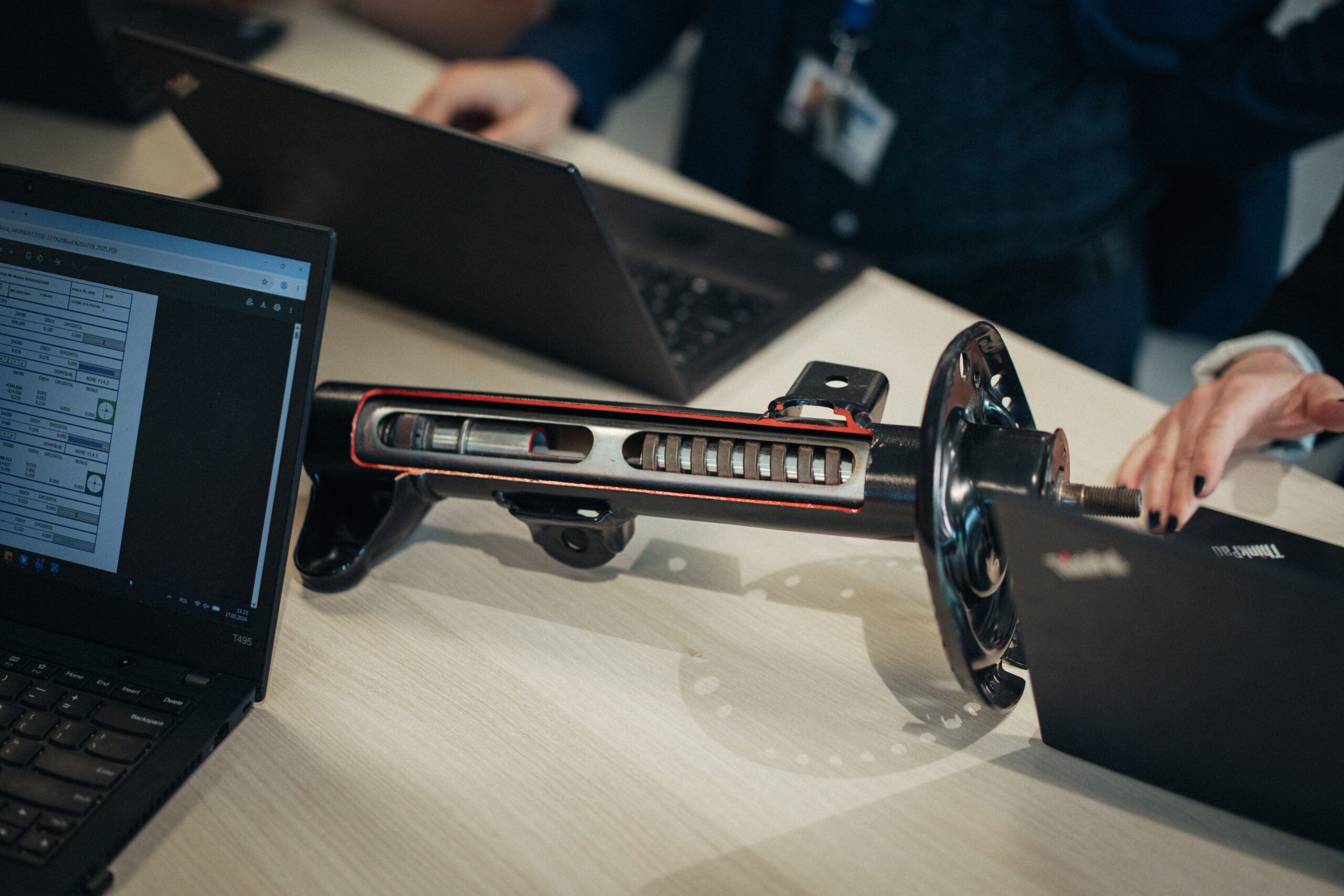
Electronically controlled dampers can get most of the attention when discussing suspension technologies, but it is still passive dampers that are doing most of the work. Estimates indicate that electronically controlled dampers are fitted to only around 10-15% of new vehicles in Europe, leaving passive dampers responsible for the majority of suspension applications.
So making passive as good as possible still matters. Passive does not mean primitive. BWI Group’s lineage of shock absorber design and manufacture reaches its centenary in 2027, and its Krosno plant alone has built more than 300 million dampers so far. Mateusz Gawlik, Product Engineering Supervisor and Technical Expert at BWI Group, explains what a modern passive damper does that its predecessor could not, and where its limits are.
Why does a passive damper still have a place?
Price, first of all. Passive dampers are much cheaper, and that includes service over the life of the car. Then mass. Across the industry, whatever the powertrain, customers have very aggressive mass targets, because every kilogram saved improves efficiency and range. On an electric vehicle there is the added pressure to fit as much battery into the car as possible. A passive damper weighs less than a controlled damper, so it helps on both counts.
A passive damper is also relatively simple: a piston rod, a tube, a bracket and spring seats, with everything it needs to do its job built inside it. There is nothing to connect to the vehicle’s electronics. It is not a lesser part, either. The mileage and the years the damper has to remain functional are more or less the same for passive and controlled. Combine that durability with the performance a modern passive damper delivers, and it is the right answer for a very wide range of vehicles.
Which applications suit a passive damper, and which suit a controlled one?
It depends on how the vehicle will be used and what the customer wants from it. Passive dampers cover the whole spectrum, from small city cars up to light commercial vehicles. Controlled dampers are typically fitted where the customer wants an extra level of luxury or additional features, such as switchable drive modes. There are also applications that offer both, giving consumers the option to decide.
How different is a passive damper today from one built 20 years ago?
Dampers today are noticeably bigger than they were 20 years ago, because cars are heavier. That is not only down to batteries. Additional safety features, stronger body structures and far more wiring have all added mass. Piston rod diameter, reservoir tube diameter and wall thickness, bracket thickness and module spring stiffness have all grown to match.

How has the functionality changed in that time?
It has changed a lot. We now have what we call ‘passive plus’ functions, which bridge the gap in capability between a purely passive damper and a controlled one. They adjust the level of damping according to, for example, the frequency of the input from the road or the position of the wheel in its travel, improving ride and handling without electronic control. At BWI Group, we have engineered a suite of technologies around this.
Have these technologies already been introduced in the industry?
Yes, and across a very wide range of vehicles such as small city cars, premium models, SUVs, fully off-road vehicles and even bespoke armoured vehicles. Our hydraulic rebound stop (HRS) has been in series production since 2011. Its first application was the Citroën C4 Cactus (E3). The hydraulic compression stop (HCS) started production in a low damping (LD) version in the BMW 3 Series in 2018, and a high damping (HD) version was introduced in the Polestar 5 in 2025. We have also developed the Frequency Sensitive Orifice (FSO) system and are developing an amplitude selective damping (ASD) valve for a well-known premium European vehicle manufacturer. Both are only a few steps away from mass production.
What do the hydraulic stops add?
HRS and HCS add damping at the end of the rebound and compression strokes. HRS not only eliminates topping noise, the knock that can occur when a damper reaches full extension, to help with NVH levels but it can also significantly reduce the peak loads going into the body. That matters because body structures and suspension components have to be engineered to withstand those peaks, so reducing them allows the body and components to be made lighter. With HRS, we can also tune how progressively the damping force builds, how long its operating range is and how much additional force it delivers at its peak. That makes it an effective way of controlling heave and roll. HCS works at the other end of the stroke. It adds damping force as the damper approaches full compression, which improves handling and reduces the peak force transferred to the body during an extreme event, such as hitting a kerb, or when the vehicle is overloaded. Compared with a damper without HCS, those peak forces can be up to 50% lower. Energy that would normally accumulate in the jounce bumper is dissipated by the damper instead, through a smooth, progressive increase in end-of-travel load. It is as tuneable as HRS, and we are one of only a few manufacturers applying it. Together, HRS and HCS are a beautifully simple and powerful solution, and we see them as a benchmark for end-of-stroke damping.
What can a passive damper do that people assume needs electronics?
Getting the balance between comfort and handling stability right. Most people assume that takes an electronically controlled damper, but passive plus technologies give our engineers another tuning tool to help achieve it. A passive damper equipped with FSO, for example, can strike that balance in many of the conditions a car meets every day.
FSO is a bypass valve that runs in parallel with the main rebound valve, fully integrated into the piston valve assembly. At the same damper velocity, the force it produces falls as the frequency of the oscillation rises. What this means is the damper stays firm at around 1 Hz, typical of body motion, and softens at higher frequencies, where the wheel is reacting to sharp inputs from the road. In one example, the same valve delivers around twice as much rebound damping force at low frequency as it does at high frequency, with no electronics involved.
What other technological developments have there been?
A lot of engineering effort has gone into designing and optimizing features that makes vehicles more fun to drive without compromising noise or endurance. But some of the biggest developments have been in the manufacturing process. Quality checks on the production line have become far more rigorous too, which means more consistent performance and better reliability from one damper to the next. The other focus is mass. BWI Group has developed a patented technology that can vary the wall thickness of the reservoir tube along its length: thicker at the bottom, where it meets the knuckle, and thinner further up. That takes between 10 and 20 per cent out of the damper’s mass. Since 2013, we also have a composite spring seat in production that is around 50 per cent lighter than the steel part.
Where does passive reach its limit?
A passive damper has one curve, defined in the factory. To change it we have to change something inside the damper, by redefining the valve code. A controlled MagneRide damper offers far greater tuneability. It can change its characteristic in real time, up to a thousand times a second, from software, and it can be retuned without touching the hardware. Anything that needs the car to adapt while it is moving, such as selectable drive modes or a response to the road ahead, needs a controlled system. That flexibility is the real strength of a controlled damper, and it is why the cars that need it get MagneRide.
Where does passive go next?
Further along the path of virtual tuning and virtual validation. The ride session with the customer is still where sign-off happens, but more of the work now happens before it. Some customers already tune virtually using a digital twin, or virtual model, of our dampers. That significantly reduces the number of physical prototypes needed, which saves time and cost, and it helps to close the gap to controlled suspension, where much of the tuning can already be done in software.
The other change may come from materials, and this applies across the whole automotive industry, not just to passive dampers. OEMs are paying more and more attention to potentially hazardous materials and substances, such as per- and polyfluoroalkyl substances (PFAS), metals like lead and chromium VI, driven by European Union regulations including REACH and the End-of-Life Vehicles rules. In a damper, PTFE, which belongs to the PFAS family, is typically used in components where low friction, wear resistance, temperature resistance and chemical compatibility with damper oil are critical. Finding alternatives is not easy or cost-effective, but I think it will happen eventually. It will not be a game changer, but the industry will need to understand what it means for the cost and durability of a shock absorber.