BWI Group’s Technical Centre Krakow has developed a bespoke artificial intelligence (AI) FEA tool. In a recent demonstration project it cut air spring development time from weeks to roughly one hour and uncovered a viable design that experienced engineers had already ruled out. We sat down with Miroslaw Siemieniuk, FEA Manager at BWI Group, to find out how it works, what it found, and why he believes the engineer’s role becomes more important, not less.

Q: Miroslaw, let’s start with the wider picture. Why have you and the team developed this AI-powered FEA tool?
A: That’s agood question. The automotive industry has changed rapidly over the last 10 years or so. Due to safety and electrification vehicles continue to increase in mass and at the same time development timescales are reducing. This is having a significant impact on chassis engineers, who are now being asked to land on tighter performance targets inside narrower programme windows.
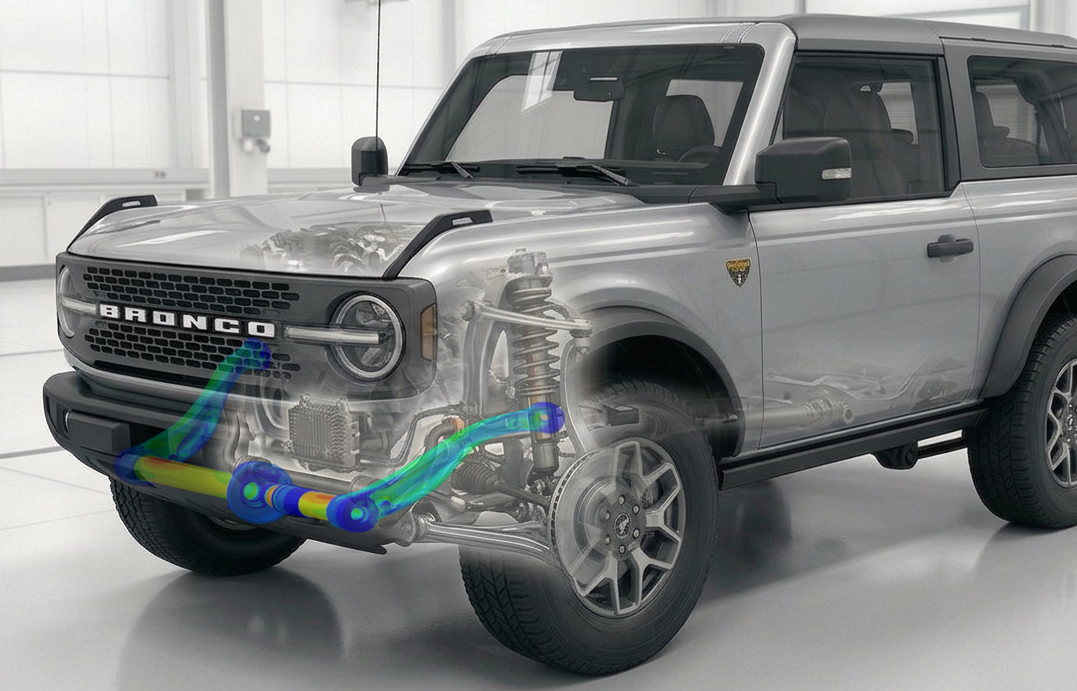
Air suspension is a good example of where these pressures are being felt. Ride, handling, comfort and durability are governed by a large set of design variables that interact in tightly coupled, non-linear ways and resolving them is challenging. So there was a clear opportunity here to benefit from the potential AI has to offer.
Q: Walk us through how an air spring is typically developed today. Where does the bottleneck sit?
A: Typically, the starting point is a force-versus-displacement performance curve supplied by the OEM. This defines exactly what the air spring is required to deliver across its full stroke. Our aim is to try and develop a product that matches that curve as closely as possible.
However, due to the many linked interactions of the various components in an air suspension system, hitting that curve and satisfying a number of other conflicting requirements and constraints is rarely straightforward. Internal geometry, working pressure, sleeve material behaviour and reinforcement layout all influence the result. The current approach is iterative manual design, with each step supported by finite element analysis (FEA). For a capable team, converging on a workable design typically takes several weeks.
Q: How does the new AI-powered FEA tool change that?
A: In short,it replaces the repeated manual iteration with a deep-learning surrogate that evaluates design changes almost instantly. This is why Ai in engineering can excel. On the particular air spring used in this study, the full optimisation completed in approximately one hour. So, compared to a typical two-week baseline, that is a 98 percent reduction in process time.
Q: How is the deep-learning model built?
A: The surrogate is a five-layer deep neural network. Importantly, it has been trained on a set of 180 high-quality FEA datasets. Those datasets came from simulation models that had already been correlated against extensive laboratory testing. So we know the models have been physically verified and the network is learning from solid engineering data.
From that training set, the network learns the mapping between the air spring’s design parameters and its resulting force-displacement behaviour and is then used as a fast-evaluating surrogate for the underlying FEA. As with all simulation processes, accuracy and correlation are critical. Against the simulation reference, the model achieved an R-squared of 0.99. In other words, there is strong agreement between its predictions and full FEA outputs.
Q: What design parameters does the model currently optimise?
A: At present, the neural network is wrapped around five design parameters: piston radius, low support radius, sleeve thickness, design pressure and nylon fibre cord angles. A Newton-based optimisation algorithm drives the search, looking for the combination of those parameters that minimises the residual error between the surrogate’s predicted force-displacement curve and the OEM’s target. The resulting root mean square error came in at approximately two percent, which indicates that the expected system behaviour closely matches the target. Once an optimal configuration is identified, the candidate design is subjected to a final detailed FEA for validation.
Q: Did the model uncover anything that was unexpected?
A: It certainly did. During the manual phase of the project, the team had concluded that the target force-displacement curve could not be matched within the existing architecture without adding a specific structural constraint component.
However, the AI tool had a different answer. It identified a combination of parameters that met the target curve inside the defined parameter space without the additional component. Manual iteration had not highlighted it because the number of interacting variables put it outside what could realistically be searched by hand inside any reasonable programme timeline.
It is important to emphasise that this is a demonstration of feasibility. The project has not been signed off for production. Translating it into hardware would still require full testing and validation. But, I think it clearly demonstrates the value of AI in surfacing non-intuitive solutions.
Q: If this approach were ultimately validated for production, what would the implications be for OEMs?
A: The implications of developing a design that does not require this additional structural component are significant. Removing it would lower mass, reduce cost, simplify the assembly process and remove the tooling associated with that hardware. More generally, the workflow gives engineering teams a clearer view of where the limits of a given suspension architecture actually sit.
Q: What does this mean for the engineer’s role in suspension development?
A: At BWI Group, AI is treated as an extension of our engineering practice. Its effectiveness depends heavily on engineering judgement. You can have the best tool in the world, but if you don’t know how to use it then it has little value. The quality of the FEA training data, the assumptions baked into each simulation model and the choice of which parameters to expose to the network all need experienced hands and understanding.
Building and validating the simulation models that produce the training data is itself a substantial engineering exercise. If the model is fed bad data, you will only get bad results. Without a credible physical foundation underneath it, the AI model’s outputs lose meaning quickly. What changes for the engineer is where they can now focus their efforts. Repetitive iteration is what gets automated, so the work can instead shift towards innovation.
Q: Where does the methodology go from here?
A: The five-parameter version described here is just the first version. There is clear scope for growth and future iterations will add more design variables, such as sleeve height, piston geometry and air spring volume. The methodology itself is not specific to air springs. So the same approach is now being applied to other suspension sub-systems, including passive valve set ups.
Q: Final thought. What is the broader lesson from the project?
A: A properly grounded surrogate model can do two things at once: compress the development timeline by orders of magnitude, and reveal design solutions that engineers simply do not have time to find. The engineering fundamentals come first, and the AI amplifies what our teams can achieve with them.